It is time to replace an aging building system when repairs cost more than half the price of new equipment, the same failure keeps returning, or parts are getting hard to find. A building maintenance system that records age, cost, and repair history makes that call clear. JDB Service Group uses this framework with facility directors across southeastern Pennsylvania.
Most of the facilities we maintain, including senior living communities, behavioral health centers, and human services organizations, run equipment from several decades side by side. Our capital planning service puts every major system on one schedule, so replacements show up in the budget years ahead instead of on the day something fails.
Why Repair-or-Replace Decisions Usually Happen at the Wrong Time
Most repair-or-replace decisions get made during a breakdown. A boiler fails in January, a technician quotes the repair, and the facility director has hours to decide. Under that pressure, the repair almost always wins, even when the system is near the end of its life.
Repeated repairs on a failing system are how a deferred maintenance backlog grows. Each fix is reasonable on its own, but together they can cost more than a planned replacement and leave the building one failure away from an outage. For residential programs, that outage can mean relocating residents or answering to a licensing inspector.
What a Building Maintenance System Should Track for Each Asset
A fair repair-or-replace call depends on five pieces of information for every major system. JDB Service Group collects them during the first facility walkthrough and keeps them current with every service visit, so the record is ready before the decision is.
- Install date and the system’s expected service life
- Repair history for the last two to three years, including the cost of each visit
- Current condition from the most recent inspection
- Estimated replacement cost, including installation and removal of the old equipment
- Whether parts, refrigerant, and qualified technicians are still available
Without this record, every decision starts from scratch. Our work-order management process builds the history as we go, because every repair is logged against the equipment it was done on.
Five Questions That Decide Repair or Replace
The repair-or-replace framework comes down to five questions: age, cost, frequency, serviceability, and risk. No single answer settles it. A system that fails two or three of these questions belongs on the replacement plan, even if today’s repair is small. JDB Service Group works through all five with facility directors before recommending either path.
1. How Old Is the System Compared With Its Expected Life?
Age alone does not condemn a system, but it sets expectations. Many commercial rooftop units and split systems are planned for about 15 to 20 years of service, while well-maintained boilers often run longer. Once a system passes roughly three-quarters of its expected life, every major repair should start a replacement conversation.
2. What Does the Repair Cost Compared With Replacement?
Many facility managers use the 50 percent rule: if a single repair costs more than half the price of new equipment, replacement is usually the better spend. It works as a screening tool, not a final answer. A repair at 40 percent of replacement cost on a 22-year-old boiler is a different decision than the same repair on a 9-year-old one.
3. How Often Has It Failed Recently?
One repair a year is normal wear. Three or more service calls on the same unit in a year usually means the system is failing one part at a time. Repeat failures also cost staff time, resident comfort, and after-hours callouts that never show up on the repair invoice.
4. Can It Still Be Serviced?
Older systems get harder to support as manufacturers drop parts and fewer technicians work on the equipment. Cooling systems built around R-22 refrigerant are a common example, since new R-22 production ended in 2020 and repairs now depend on reclaimed supply. When parts take weeks to arrive, a breakdown costs more even if the repair price does not change.
5. What Happens If It Fails?
Some systems carry more risk than others. Heat in a senior living building, hot water in a residential program, and emergency power all affect resident safety and licensing. These systems should be replaced earlier, on a planned schedule, rather than run until they fail.
Repair or Replace: How the Signs Compare
Repair usually makes sense for a mid-life system with an isolated problem. Replacement planning makes sense when the system is late in its life, failing often, or hard to service. JDB Service Group uses the comparison below as a starting point when reviewing aging equipment with facility directors.
| Factor | Repair usually makes sense | Plan for replacement |
|---|---|---|
| Age | Less than about half of expected service life | Past about three-quarters of expected service life |
| Repair cost | Well under half of replacement cost | Near or over half of replacement cost |
| Failure history | One or two calls a year with different causes | Three or more calls a year, or the same failure returning |
| Parts and refrigerant | Readily available | Discontinued, reclaimed only, or long lead times |
| Impact of failure | Comfort or convenience | Resident safety, licensing, or a building-wide outage |
| Operating cost | Energy use and run times steady | Energy use and run times climbing year over year |
JDB Service Group evaluates aging building systems on five factors: age, repair cost, failure frequency, serviceability, and the impact of a failure on residents and operations. For institutional facilities in southeastern Pennsylvania, systems that fail two or more of these tests are moved onto a planned replacement schedule.
How Facility Maintenance Planning Turns Replacement Into a Budget Line
Facility maintenance planning means scheduling repairs and replacements years ahead, based on each system’s age and condition. When a boiler is expected to need replacement in three years, the cost can be set aside, approved by a board, or written into a funding request. That is much easier than finding emergency money in the middle of heating season.
For nonprofit and agency-funded organizations, timing matters as much as the equipment. Planned replacements can be scheduled in milder months, around resident routines, with temporary equipment arranged ahead of time when needed. JDB Service Group builds these plans into our commercial building maintenance programs, so the same team that services the equipment also tracks when it is due.
How JDB Service Group Handles a Repair-or-Replace Decision
JDB Service Group handles repair-or-replace decisions in four steps: assess the system, price both options, rank the decision against the rest of the facility, and record the plan. Facility directors get a clear recommendation with the reasoning behind it, not just a repair quote.
Step 1: Assess the System
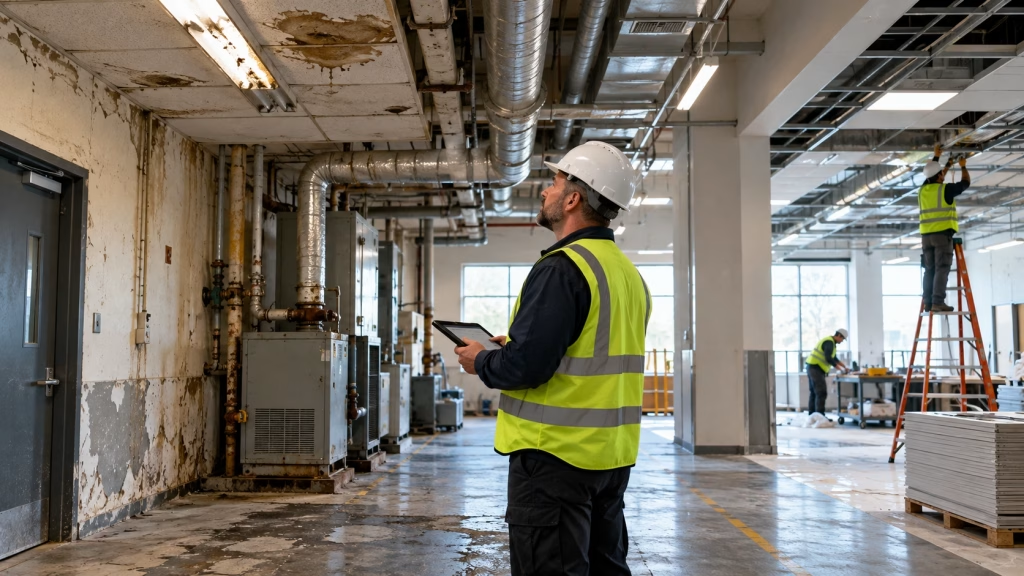
Our team inspects the equipment, reviews its repair history, and confirms its age and remaining life. We also check whether parts and service support are still available for that model.
Step 2: Price Both Paths
We price the repair and the replacement side by side, including installation, removal of the old equipment, and any work needed to meet current code. Seeing both numbers together often settles the decision.
Step 3: Rank It Against the Rest of the Facility
One aging system is rarely the only one. We place each recommendation within the facility’s full list of needs, so the most critical replacements are funded first and lower-risk systems are kept running with targeted repairs.
Step 4: Record the Plan and Follow Through
Every decision is logged, whether the choice is to repair now and replace in two years or replace this season. Systems kept in service stay on a monitoring schedule, which makes it less likely that a planned replacement turns into an emergency one.
We provide this support for organizations in Montgomery County and throughout Bucks, Chester, Delaware, and Philadelphia Counties. Our team has maintained institutional facilities in the region since 1998.
JDB Service Group has provided commercial property maintenance across southeastern Pennsylvania since 1998. The company helps senior living communities, behavioral health centers, and human services organizations decide when to repair or replace aging HVAC, boiler, plumbing, roofing, and electrical systems, then builds those replacements into a multi-year capital plan.
Frequently Asked Questions
What is the 50 percent rule for repairing or replacing equipment?
The 50 percent rule says that if a single repair costs more than half the price of new equipment, replacement is usually the better investment. JDB Service Group uses it as a first screen for HVAC, boilers, and water heaters at institutional facilities across southeastern Pennsylvania, then weighs the system’s age, failure history, and parts availability before making a recommendation.
How long do commercial building systems usually last?
Service life depends on the system and how well it is maintained. Many commercial rooftop units are planned for about 15 to 20 years, and well-maintained boilers often last longer. Consistent commercial building maintenance helps equipment reach its expected life. JDB Service Group tracks the age and condition of each system for facilities in southeastern Pennsylvania so replacements can be planned ahead.
What does facility maintenance planning include?
Facility maintenance planning includes an inventory of major building systems, each system’s age and condition, its expected replacement year, and an estimated cost. JDB Service Group builds these plans for senior living, behavioral health, and human services facilities across southeastern Pennsylvania, so directors can budget for replacements, seek board approval, and schedule work before equipment fails.
Get a Clear Answer on Your Aging Systems
JDB Service Group helps facility directors across southeastern Pennsylvania decide which systems to repair, which to replace, and when. Contact us to schedule a facility assessment.